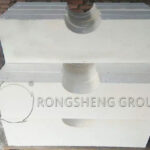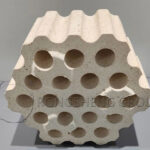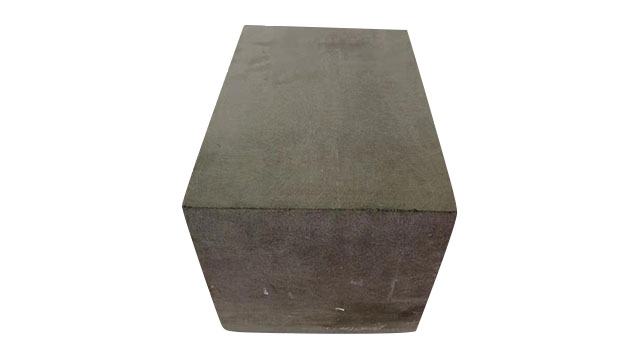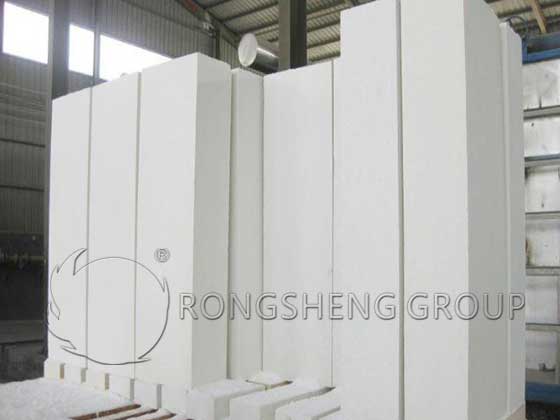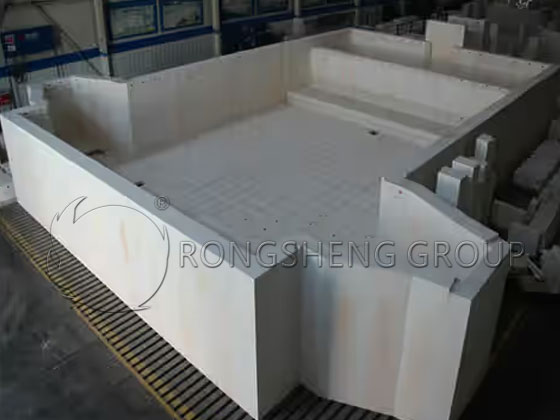
Lid bricks used in rolled glass production are classified into various types based on their material, including low-porosity clay, zircon mullite, α-β corundum, sillimanite, and fused silica. Currently, most solar rolled glass production lines use lip bricks made of zircon mullite, sillimanite, and α-β corundum.
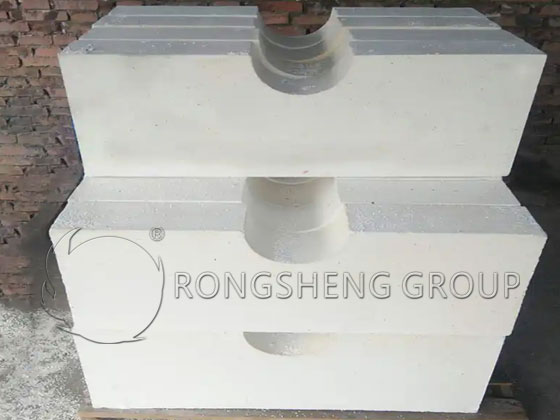
Material of Lid Bricks
- ① Zircon-Mullite Lid Bricks. The main components of zircon-mullite lip bricks are ZrO₂≥6%, Al₂O₃≥75%, SiO₂≤18%, and Fe₂O₃≤0.5%. They are made from industrial alumina (or high-alumina bauxite) and zircon, mixed, shaped, dried, and then fired at high temperatures in a shuttle kiln using a reaction sintering process. Zircon-mullite lip bricks possess a dense crystal structure, high mechanical strength at high temperatures, good wear resistance, good thermal shock resistance, low reheat shrinkage and high-temperature creep, and extremely high chemical stability and resistance to alkaline media erosion. Their room temperature compressive strength is ≥100MPa, load softening start temperature is ≥1670℃, bulk density is 2.8g/cm³, and air-cooled thermal shock resistance is ≥10 cycles. Zircon mullite lip bricks are increasingly used in solar rolled glass production lines due to their excellent wear resistance, long service life, short defoaming time, minimal impact on forming after lip wear, and high cost-effectiveness.
- ② Sillimanite Lid Bricks. Sillimanite, with the molecular formula Al₂O₃·SiO₂, has a theoretical chemical composition of 62.93% Al₂O₃ and 37.07% SiO₂. Typically, sillimanite contains ≥55% Al₂O₃, ≤37% SiO₂, and ≤5% Fe₂O₃, TiO₂, CaO, MgO, Na₂O, and K₂O, making it a high-quality, high-alumina raw material. Sillimanite, when sintered at high temperatures of 1500–1750℃, irreversibly transforms into 83.96% mullite (3Al₂O₃·2SiO₂) and 16.04% silicate glass phase, a process known as sillimanite mutation. Mulled sillimanite can produce high-density clinker with a porosity of less than 3%, which, after being crushed, can be used to make refractory materials, including lip bricks. Lid bricks made from sillimanite can be used in high-temperature operations up to 1650℃, exhibiting advantages such as high high-temperature strength, low porosity, good volume stability and thermal shock resistance, and resistance to molten glass erosion. Therefore, sillimanite lip bricks are also used in solar rolled glass production lines.
- ③ α-β corundum lip bricks. Corundum lip bricks are made from raw materials containing ≥94% alumina, ≤1.2% Na₂O, and ≤0.02% Fe₂O₃, through high-temperature alumina melting and casting in an electric arc furnace at temperatures above 2000℃. Alpha-β corundum products are composed of α-alumina and β-alumina, with their interlocking crystals forming a very dense microstructure, exhibiting excellent alkali resistance. In temperature ranges below 1350℃, its resistance to glass melt erosion and scouring is better than that of zirconia corundum bricks, possessing good mechanical strength and a long service life. Because it contains almost no impurities such as Fe₂O₃ and TiO₂, its matrix glass phase is extremely low, with a porosity ≤2% and a bulk density of 3.4 g/cm³. It produces very few bubbles or other foreign matter when in contact with molten glass, making it the best material for producing lip bricks. However, α-β corundum lip bricks have poor thermal stability, are prone to cracking, and are expensive, limiting their widespread use in lip bricks for solar rolled glass lines.
Regardless of the lip brick material, its appearance quality must meet the following requirements: the upper surface must be smooth and flat, free of molten pits. The lip brick rim must not have cracks, and even less so, any gaps or defects. The working surface and all contact surfaces must be finely ground to a fineness of ±0.5mm; the curvature of the lip bricks must be consistent.
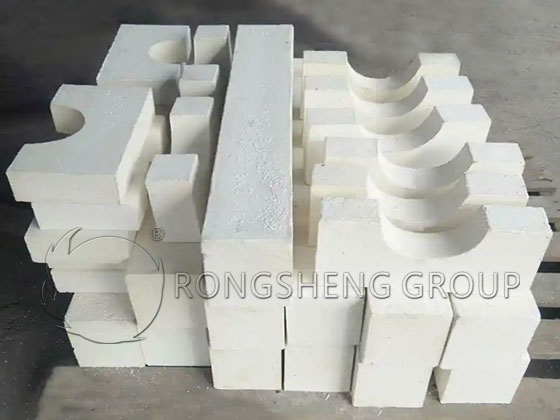
Causes and Prevention of Cracks in Lid Bricks
Lip bricks are a special type of irregularly shaped refractory material. The raw material composition, forming and manufacturing process, and assembly all affect their service life, especially during the hammering and ignition processes, where the brick must withstand temperature differences of hundreds of degrees Celsius. Therefore, whether using a single brick or a combination of several bricks, cracking is a potential problem. The following lists the causes and prevention measures for cracks in lip bricks.
- ① The brick material itself has low compressive strength, poor thermal stability, and a high coefficient of thermal expansion. When subjected to thermal shock, the tensile strength of the brick is less than the expansion thermal stress, causing it to break. To eliminate this factor, in addition to designing a good formula and selecting good materials, the contact surfaces of the top screws and stops used to fix the lip brick with the lip brick should be padded with flexible material, and iron parts should not directly contact the brick body.
- ② Low firing temperature and a short dehydration stage of crystal water lead to the destruction of the original structure and the formation of new minerals during the high-temperature dehydration process of the crystal water inside the brick. To avoid this situation, besides avoiding components with high mineral structural water content when determining the lip brick formula, the brick blanks must be thoroughly dried after casting before firing in the kiln. Furthermore, the heat preservation period should be increased within the dehydration temperature range of the crystal water based on the mineral composition.
- ③ The lip brick is backed by the tail brick, and has screws acting on the brick body from the front and sides. When heated, forces from four directions act on the local area of the brick body. The screws restrict the expansion and movement of the brick body, but can also easily cause the brick body to crack under external force. Preventive measures: After the lip brick is fixed to the overflow support, the support should be secured with screws and bolts, but not tightly; an expansion gap should be left. Then, heat it with fire, slowly raising the temperature to above 700℃ to allow the lip brick to fully expand. Tighten the screws again before the lead-in brick.
- ④ The pre-use baking time is too short, and the free water in the brick body is not drained. To eliminate this factor, the lip brick can be placed in a high-temperature environment before use to fully drain the free water, or the kiln can be pre-heated during on-site construction.
- ⑤ Using deformed lip tile supports may cause cracks or even breakage of the lip tile. Therefore, deformed lip tile supports should not be used, especially supports with deformed contact surfaces with the lip tile.
Lip Brick Replacement
After a period of operation in a rolled glass production line, if defects appear in the glass due to erosion or wear of the lip brick, it needs to be replaced.
Before replacing the lip brick, it must be baked at a high temperature for at least 72 hours to remove free water remaining in the brick due to processing, transportation, or other reasons. Baking can be done using a natural drying method: the brick is placed next to the kiln, relying on the heat emitted by the kiln for baking. Because it is natural baking, it requires a long time and can only remove some free water, resulting in incomplete baking. Alternatively, a preheating furnace baking method can be used: a kiln is built with refractory materials, and the lip brick is heated according to a heating curve, baked at 200-300℃ for 24 hours, then assembled to the overflow port. After positioning and installation on the calender, the temperature is further increased to 1100℃ for lead-in operation. This method requires specialized hoisting and installation equipment and is more difficult to operate at high temperatures, but it ensures that the lip brick will not crack. Online baking can also be used: after the lip brick and calender are positioned and installed at the forming port, they are baked using a spray gun. This method uses gradual heating, allowing sufficient time for the free water and crystal water in the lip brick to be fully drained. This method reduces the probability of the lip brick cracking or even shattering.
Before replacing the lip brick, prepare the following tools: pipe wrench, Allen wrench, wrench, pliers, level, measuring tape, 1-3mm sheet metal, square timber, mullite fiber paper, etc.
When removing the lip brick from the calender, first use a sledgehammer and pneumatic hammer to remove the old lip brick. Then, clean the tail brick thoroughly with an electric scraper (the tail brick surface must be free of residual glass and unevenness). After applying a 3- 5 mm thick layer of high-temperature mullite fiber paper to the contact surface of the tail brick, assemble the lip brick on the lip brick support as required, or install the lip brick already assembled on the support at the tail brick location. Finally, push the calender into position, check for any problems, and then slowly heat the lip brick to the guide plate with a spray gun to complete the replacement operation.