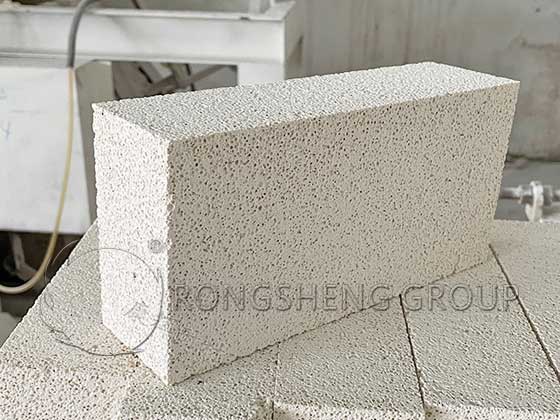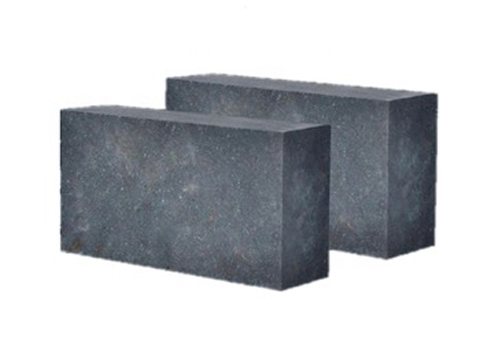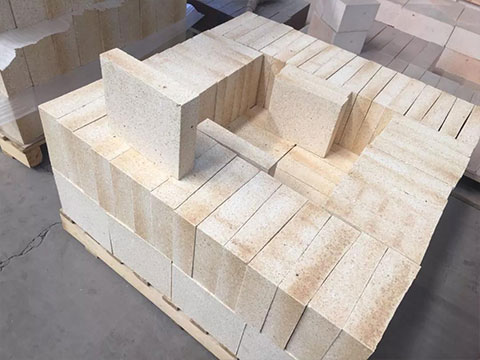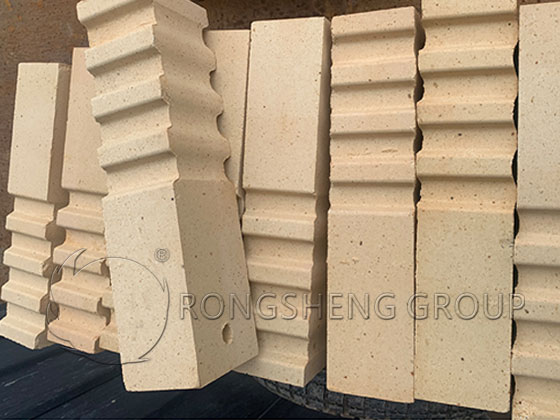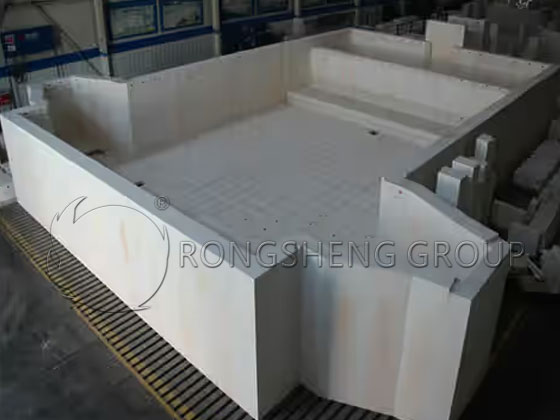
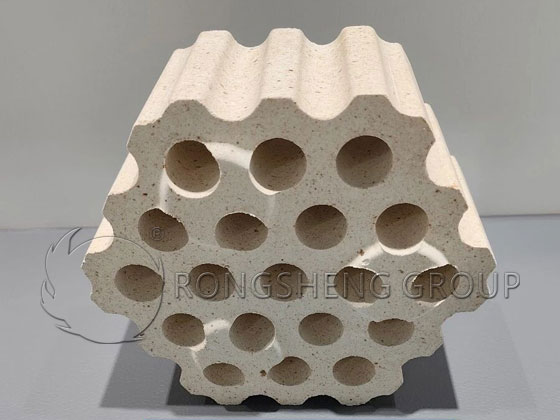
Low-creep high-alumina checker bricks are a specialized type of refractory heat-storage material distinguished by their exceptional high-temperature performance. Their core characteristics include an extremely low creep rate under high-temperature load (creep rate < 0.5% at 1350°C/0.2 MPa/50 h), robust volume stability, excellent thermal shock resistance, and strong resistance to alkali metal corrosion, abrasion, and erosion. Furthermore, they feature a refractoriness under load of ≥ 1550°C and a controlled apparent porosity ranging from 18% to 22%. These bricks are capable of maintaining their structural integrity—remaining free from collapse, pore clogging, or spalling—even under conditions of prolonged high temperatures, repeated thermal cycling, and continuous mechanical loading. Leveraging these core advantages, the product is widely utilized in high-temperature industrial furnaces across various sectors, including metallurgy, glass manufacturing, building materials, and chemicals. It is particularly well-suited for critical furnace zones that require long-term, stable heat storage and exchange while simultaneously bearing a specific mechanical load. The following section provides a detailed analysis of low-creep high-alumina checker bricks across various application scenarios, elaborating on their performance based on specific operating conditions, primary functions, and practical field applications.
Blast Furnace Hot Blast Stove Regenerator
The blast furnace hot blast stove is an indispensable piece of critical equipment in the iron and steel metallurgy industry. Its core function is to heat air to high temperatures (1100–1350°C) before injecting it into the blast furnace, thereby enhancing smelting efficiency, reducing the coke ratio, and lowering energy consumption. The regenerator chamber serves as the core zone within the hot blast stove where heat storage and exchange take place. As the primary heat-storage medium within the regenerator, low-creep high-alumina checker bricks are a critical material for ensuring the long-term, stable operation of the hot blast stove.
In terms of application placement, low-creep high-alumina checker bricks are primarily utilized in the high-temperature zones of the regenerator’s upper-to-middle sections, the areas beneath the dome, and other critical upper-layer positions within the checkerwork. These zones represent the areas within the hot blast stove subjected to the highest temperatures and the most severe operating conditions—specifically, a prolonged high-temperature environment ranging from 1100°C to 1350°C. They are subjected to alternating thermal stresses: high-temperature heating during the combustion phase and relatively lower-temperature cooling during the blast phase. This thermal cycling occurs at a high frequency (typically completing one full heat-storage and heat-release cycle every 30 to 60 minutes). Concurrently, these bricks must withstand the structural load imposed by the weight of the brick stack itself (where the pressure exerted by the upper layers of checker bricks upon the lower layers increases proportionally with the height of the stack). Furthermore, they are exposed to corrosion by alkali metal vapors (specifically K₂O and Na₂O) generated during the combustion of blast furnace gas, as well as the erosive forces of high-velocity hot airflow.
Under such harsh operating conditions, conventional high-alumina checker bricks or fireclay bricks—owing to their high creep rates and limited resistance to alkali corrosion—are highly susceptible to issues such as softening deformation, structural collapse, blockage of airflow channels, and surface spalling. Such failures lead to a decline in the regenerator’s heat-exchange efficiency and instability in the hot blast temperature, potentially triggering critical malfunctions within the hot blast stove and disrupting normal blast furnace production operations. In contrast, low-creep high-alumina checker bricks are engineered through the incorporation of modifiers—such as andalusite, kyanite, and sillimanite. During high-temperature operation, these modifiers facilitate the *in-situ* formation of an interlocking network of acicular (needle-like) mullite crystals, thereby establishing a highly stable microstructure. This mechanism effectively suppresses grain boundary sliding and high-temperature creep, while simultaneously reducing the content of low-melting-point glassy phases within the brick matrix. Consequently, these bricks exhibit enhanced resistance to alkali metal corrosion and thermal shock, ensuring that their airflow channels remain unobstructed and their structural integrity remains intact over extended periods of operation. In practical applications, low-creep high-alumina checker bricks are widely suitable for various types of hot blast stoves—including top-combustion, external-combustion, and internal-combustion designs—associated with large and medium-sized blast furnaces (ranging from 1,000 to 5,000 m³). They are particularly well-suited for the hot blast stoves of large blast furnaces where blast temperature requirements exceed 1,100°C. For instance, in a 3,200 m³ top-combustion hot blast stove, the use of low-creep high-alumina checker bricks (with an Al₂O₃ content exceeding 75%) in the upper and middle sections of the regenerator chamber can extend the service life to 8–12 years. Compared to ordinary high-alumina checker bricks (which typically have a service life of 3–5 years), this significantly extends the hot blast stove’s maintenance cycle and reduces maintenance costs. Simultaneously, it ensures the stability of the hot blast temperature, thereby providing a reliable foundation for efficient smelting operations within the blast furnace. Furthermore, low-creep high-alumina checker bricks are extensively utilized in the retrofitting of hot blast stoves for small and medium-sized blast furnaces, serving as a replacement for traditional, lower-quality checker bricks to enhance both operational stability and heat exchange efficiency.
Coke Oven Regenerators
The coke oven is the core equipment in the coking industry, primarily used for the dry distillation of coal to produce products such as coke and coke oven gas. The regenerator is a critical component of the coke oven; its function is to recover heat from the combustion waste gases, preheat the air and gas required for combustion, facilitate the recycling of thermal energy, and reduce energy consumption. Thanks to their exceptional high-temperature stability and low-creep characteristics, low-creep high-alumina checker bricks have emerged as the ideal material for the checkerwork within coke oven regenerators.
The operating conditions of a coke oven regenerator share similarities with those of blast furnace hot-blast stove regenerators, yet they also possess their own unique characteristics. The regenerator is continuously exposed to a high-temperature environment ranging from 800°C to 1200°C, while simultaneously enduring periodic temperature fluctuations (the heating cycle of a coke oven typically lasts 20 to 30 minutes, during which the regenerator alternately undergoes heat storage and heat release). Furthermore, the bricks must support their own structural weight while resisting corrosion from the trace amounts of alkali metal vapors and sulfides generated during the combustion of coke oven gas. Additionally, the relatively high airflow velocity within the regenerator imposes specific requirements regarding the abrasion resistance and erosion resistance of the checker bricks.
Within coke oven regenerators, low-creep high-alumina checker bricks are primarily utilized in the high-temperature zones located in the middle and upper sections of the checkerwork, serving as a replacement for traditional clay bricks and standard high-alumina bricks. Under prolonged exposure to high temperatures and cyclic thermal fluctuations, traditional checker bricks are prone to issues such as creep-induced subsidence, brick tilting, and blockage of gas channels. These issues lead to a decline in the regenerator’s heat exchange efficiency and may even trigger structural failures—such as deformation of the regenerator walls or air leakage—thereby compromising the coke oven’s normal production operations and service life. In contrast, low-creep high-alumina checker bricks maintain their volumetric stability under sustained high-temperature loads, resisting both creep and structural collapse, while also exhibiting excellent thermal shock resistance. This allows them to withstand cyclic thermal fluctuations effectively, thereby minimizing brick cracking and spalling. Moreover, their superior resistance to alkali corrosion and abrasion enables them to effectively withstand the corrosive and erosive effects of alkali metal vapors and high-velocity gas flows, ensuring that the gas channels remain unobstructed and guaranteeing the consistent heat exchange efficiency of the regenerator. In practical applications, low-creep high-alumina checker bricks are suitable for the regenerators of various large-scale coke ovens (including 6-meter and taller stamp-charged and top-charged coke ovens). They are particularly well-suited for coke ovens that have undergone environmental retrofits and require enhanced thermal efficiency. For instance, during the refurbishment of the regenerators in a 6.25-meter stamp-charged coke oven, the use of low-creep high-alumina checker bricks (with an Al₂O₃ content of 65%–70%) not only resolved the issues of deformation and clogging commonly associated with traditional checker bricks but also boosted the regenerator’s heat exchange efficiency by 5%–8%, resulting in a significant reduction in the coke oven’s energy consumption. Furthermore, this approach extended the maintenance cycle for the regenerators—from the original 3–4 years to 7–8 years—thereby substantially lowering the enterprise’s maintenance costs and minimizing losses incurred during downtime.
Glass Melting Furnace Regenerators
The glass melting furnace is the core equipment in the glass manufacturing industry; its function is to heat and melt glass raw materials to produce molten glass of the required quality. The regenerator is a critical component enabling heat recovery within the glass melting furnace; it serves to reclaim high-temperature heat from the furnace’s combustion exhaust gases, preheat the combustion air, thereby enhancing the furnace’s thermal efficiency and reducing fuel consumption. Given the extremely harsh operating conditions within glass melting furnace regenerators—which impose exceptionally high demands on the high-temperature performance of checker bricks—low-creep high-alumina checker bricks have emerged as one of the primary materials of choice for this application.
Characteristics of Operating Conditions in Glass Melting Furnace Regenerators: These components are subjected to a high-temperature environment ranging from 1200°C to 1400°C over extended periods. Temperatures fluctuate significantly, as the bricks alternately endure intense heating during the combustion phase and cooling during the air-blowing phase, resulting in frequent thermal cycling. Furthermore, glass raw materials contain a certain amount of alkali metal oxides (such as Na₂O and K₂O); at high temperatures, these volatilize to form alkali metal vapors, which exert a strong corrosive effect on the checker bricks, leading to pulverization and spalling of the brick bodies. Additionally, the airflow within the regenerator contains trace amounts of glass dust, which causes erosive wear on the brick surfaces and tends to clog the air channels, thereby compromising heat exchange efficiency.
The application of low-creep high-alumina checker bricks in glass melting furnace regenerators is primarily concentrated in the high-temperature zones of the middle-to-upper sections of the regenerator chamber and the upper layers of the checkerwork structure. Their core function is to withstand high temperatures, alkali metal corrosion, and thermal cycling shocks, thereby maintaining structural stability and ensuring the unobstructed flow of gases through the channels. Compared to standard high-alumina bricks or silica bricks, low-creep high-alumina checker bricks offer distinct advantages: First, they exhibit an extremely low creep rate, enabling them to maintain volume stability under prolonged high-temperature loads; this prevents the collapse or deformation of the checkerwork structure, thereby safeguarding the structural integrity of the regenerator. Second, they possess excellent resistance to alkali corrosion; by reducing the content of the glassy phase within the brick matrix, they minimize chemical reactions between alkali metal vapors and the brick material, effectively preventing pulverization and spalling. Third, they demonstrate superior thermal shock resistance, allowing them to adapt to the frequent thermal cycling inherent in glass melting furnace regenerators and effectively mitigate brick cracking. Fourthly, the pore structure is uniform, offering excellent resistance to abrasion and erosion; this effectively prevents glass dust from clogging the channels, thereby ensuring stable heat exchange efficiency.
In practical applications, low-creep high-alumina checker bricks are suitable for the regenerators of various glass melting furnaces—including those for flat glass, daily-use glassware, and photovoltaic glass—and are particularly well-suited for large-scale float glass furnaces (with a daily melting capacity of 500 tons or more). For instance, in a float glass furnace with a daily melting capacity of 600 tons, the use of low-creep high-alumina checker bricks (containing 70%–75% Al₂O₃) in the regenerator allows for a service life of 6 to 10 years. Compared to traditional silica bricks (which have a service life of 4 to 6 years), this not only extends the maintenance cycle but also reduces brick wear caused by alkali metal corrosion, thereby lowering maintenance costs. Furthermore, it ensures the heat exchange efficiency of the regenerator, resulting in a 3%–5% reduction in the glass furnace’s energy consumption while simultaneously enhancing the stability of glass production and the quality of the final product.
Metallurgical Heating Furnaces and Heat Treatment Furnaces
In the metallurgical industry—aside from blast furnaces and coke ovens—various types of heating furnaces and heat treatment furnaces represent a key application area for low-creep high-alumina checker bricks. These types of equipment are primarily utilized in processes such as the heating, forging, and heat treatment of ferrous and non-ferrous metals; they operate continuously within high-temperature environments and demand high standards regarding heat storage, heat exchange efficiency, and structural stability.
Specifically, low-creep high-alumina checker bricks are predominantly employed in the high-temperature heat storage and heat exchange structures—as well as the load-bearing sections—of equipment such as walking-beam heating furnaces, pusher-type heating furnaces, regenerative industrial furnaces, and non-ferrous metal smelting furnaces. The operating conditions characteristic of this equipment involve prolonged exposure to high-temperature environments ranging from 900°C to 1300°C. Furthermore, certain equipment (such as regenerative heating furnaces) requires repetitive heat storage-release cycles, involving frequent thermal cycling between hot and cold states. During the heating of workpieces within these furnaces, intense high-temperature radiant heat is generated, while simultaneously, high-velocity gas flows exert an erosive scouring effect on the furnace structure. Additionally, some equipment must bear the weight loads of the workpieces themselves or the self-weight of the refractory lining; consequently, these applications impose stringent requirements on the material’s high-temperature stability, creep resistance, thermal shock resistance, and abrasion resistance.
In walking-beam and pusher-type heating furnaces, low-creep high-alumina checker bricks are primarily utilized in the load-bearing sections of the furnace hearth and the high-temperature zones of the side walls. Their function is to support the weight of the workpieces and withstand high-temperature radiant heat, thereby maintaining the structural integrity of the furnace body. This prevents furnace deformation or structural collapse that could otherwise result from high-temperature creep. Concurrently, they facilitate the uniform distribution of heat, ensuring that the workpieces are heated evenly. In regenerative industrial furnaces, low-creep high-alumina checker bricks serve as heat storage media, recovering thermal energy from combustion waste gases to preheat the combustion air and thereby enhance the furnace’s thermal efficiency. Their inherent low-creep characteristics ensure the long-term structural integrity of the heat storage matrix, prevent the clogging of gas channels, and guarantee the stable execution of the heat storage-release cycles. In non-ferrous metal smelting furnaces, low-creep high-alumina checker bricks are deployed in the high-temperature load-bearing sections and heat storage zones of the furnace structure; here, they withstand the high-temperature corrosion and erosive scouring associated with the non-ferrous metal melting process, thereby maintaining the structural stability of the furnace and extending the operational lifespan of the equipment. For instance, in walking-beam heating furnaces used for large-scale steel forging, the furnace hearth is constructed using low-creep, high-alumina checker bricks (with an Al₂O₃ content of 65%–70%). These bricks are capable of withstanding the weight of the steel stock over extended periods within high-temperature environments of approximately 1200°C without undergoing creep or deformation, thereby ensuring the proper operation of the walking beams. Concurrently, this reduces wear on the hearth bricks and lowers the frequency of replacement—extending the service interval from once a year to once every 3 to 5 years—which significantly reduces the enterprise’s maintenance costs and losses associated with downtime. In regenerative non-ferrous metal smelting furnaces, the utilization of low-creep, high-alumina checker bricks as heat-storage media has resulted in an 8% to 10% improvement in heat exchange efficiency and a significant reduction in energy consumption. Furthermore, the service life of the heat-storage media has been extended to 5 to 7 years, thereby enhancing the operational stability of the equipment.
Rongsheng High-Alumina Checker Bricks
Composition of High-Alumina Bricks and Applications. Rongsheng High-Alumina Checker Bricks Applications. Taken collectively, the application scenarios for low-creep high-alumina checker bricks share distinct common characteristics. They are invariably situated in long-term high-temperature environments (ranging from 800°C to 1500°C) and are required to withstand specific structural loads. Furthermore, they face harsh operating conditions involving repeated thermal cycling, erosion by high-temperature gas flows, and corrosion by alkali metals or other aggressive substances. Consequently, these applications impose extremely rigorous demands on the material’s volume stability, creep resistance, and thermal shock resistance. Their primary application domain is concentrated within the metallurgical industry—specifically in blast furnace hot blast stoves, coke ovens, and heating furnaces—followed by high-temperature kilns in the glass, building materials, and chemical sectors. Their core function serves a dual purpose: acting as both a heat storage medium and a load-bearing structure to ensure the kiln’s heat exchange efficiency and structural integrity, thereby extending the service life of the equipment while simultaneously reducing maintenance costs and energy consumption.
As industrial technologies continue to advance, the requirements for thermal efficiency, operational stability, and service life across various types of high-temperature kilns are constantly escalating. Thanks to their exceptional high-temperature performance, the application scope of low-creep high-alumina checker bricks continues to expand. They are poised to play an increasingly pivotal role, particularly within large-scale, high-efficiency, and environmentally friendly industrial high-temperature kilns.